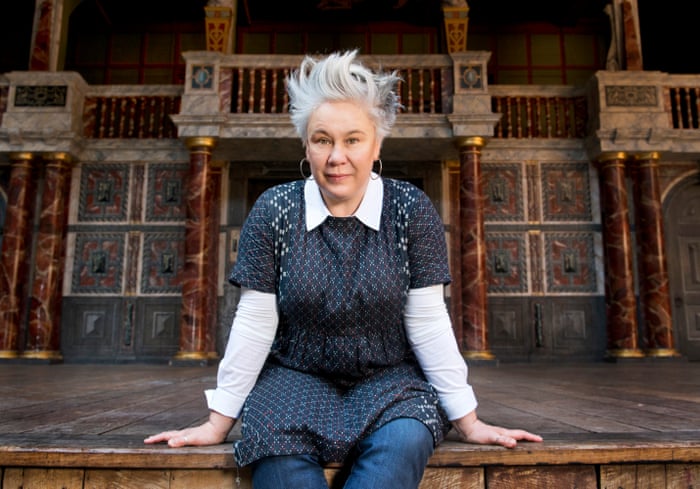
Emma Juliet Rice is an English actress, director and theatre professional. In January 2016 she was appointed to be the artistic director of Shakespeare’s Globe in London. Formerly known as the artistic director of the Kneehigh Theatre in Cornwall, England. She was born in 1967 (age 53 years), Chipping Norton and studied at Guildhall School of Music & Drama.
Emma Rice from a young age always knew she wanted to get involved in the performing arts industry thanks to her parents always taking her to the theatre at a young again. Throughout her life she had made numerous, ridiculous plays as she puts it all her life. She never thought she’d just become a director, her acting helped her to step up into it. For 10 years she worked with different directors and different methods in order to sharpen her skills and become well rounded in the big world of theatre and directing.
Started to perform at Kneehigh in 1994. Bill Mitchell and Mike Shepherd who were the Kneehigh Artistic directors eventually gave her the opportunity to direct, and she rose to prominence with ambitious performances that included productions in London’s West End as well as smaller theatres. Rice says that her long-running production of The Red Shoes represented a turning point in her career when she came into her own.
What are the main characteristics of Emma Rice’s work?
The main one would be how she creates a scenario where it can feel very personal. The best way to describe it, is how one may love something or is inspired by it so much that they have a need to be part of that world only in the way in which they see it. Draws ideas from her own experiences and brings to life a new perspective of an old classic, fairy tale or myth.
“There was no hiding behind a character, you had to be yourself, weaving a story, using your imagination, engaging a young audience. You can see the thread of that experience running through my work to this day.”
Emma Rice
https://www.thestage.co.uk/features/emma-rice-i-want-to-entertain-on-an-old-fashioned-level
“The Red Shoes,” the heroine must decide whether to wholeheartedly embrace the dance or live a more conventional life, just as Rice herself had to decide whether to live the life of an artist or a tamer existence.
As a result, Rice has always understood that harnessing the expertise and contributions of everyone in the room makes for a richer, more diverse, and more boldly textured theatre. An Emma Rice production values clowning as much as it sets store by fine acting; it is likely to meld popular music with classical sounds; and it constantly performs a high-wire act as it negotiates the tragic and the pantomimic, daft comedy and bruising truths. If much British theatre of the last 20 years has been knowing and ironic, Rice’s work has been distinctive for the way it wears its heart on its giddy sleeve.
Lyn Gardner
How does she explain her creative process?
It’s all done instinctively; goes off her instincts and tells her stories at the time she thinks they’re needed the most. She is emotionally drawn to certain plays.
Rice brings old classics into a new era, loving the fact that an old story can feel new again just by changing the date, the political time, the place where it could be set and overall the need to change because that is the only certain thing that can be promised in life.
Rice’s gift has been her ability to take these age-old tales and turn them into stories about how we might live now. These involving: The Red Shoes, The Wooden Frock (2003), Rapunzel (2006), The Little Matchgirl (2016), and Shakespeare’s most fairytale-like play Cymbeline.
Lyn Gardner
https://www.digitaltheatreplus.com/education/news/lyn-gardner-on-theatre-and-performance-emma-rice-directing-theatre%E2%80%A6-and-being
Looking for actors, she looks for someone she can play with, have fun with who she can relate too. Rice doesn’t class herself as a psychological or intellectual director, it all goes back to the imagination and creatively of it all. Getting to know the essence of the actor is the main goal, why are they here, what is driving them to perform, someone who can inspire Rice as well as knock her off her feet with all their tricks!
Rice brings old classics into a new era, loving the fact that an old story can feel new again just by changing the date, the political time, the place where it could be set and overall the need to change because that is the only certain thing that can be promised in life.
Why was her role as Artisitc Director of the Globe Theatre so controversial and short lived?
To put it simply she didn’t stay within their guidelines, she wanted to create her plays in a way that were different, unique to her style. Only two seasons as its artistic director before in April 2018 she walked away. The Globe prides itself on naturalistic effects, something she didn’t do. Her production of, “A Midsummer Night’s Dream,” incorporated an unconventional use of sound and lighting having a distant disco feel to it. I believe that’s a cool, fine way of portraying the otherwise consistently performed play. Sadly the board didn’t trust her artistic vision which in a way in wrong considering they knew what they were getting involved with when first hieing Emma.
“The heavens opened as I left,” she remembers, “and something washed away at that moment. I had such a sense of the narrative of my life…”
Emma Rice
Though she went on to open up her own theatre, “Wise Children,” and went on to carry on loving her career, leaving the Globe left a hole in her heart she’ll never be able to refill.
Not that I wanted what happened to happen – I didn’t. I will miss it until the day I die.”
Emma Rice
She loved the space, audience and excitement at the Globe.
The Observer’s theatre critic, Susannah Clapp, argues that Rice – lighting issues aside – understood the “deeper spirit of the Globe, the immediacy between audience and actors”, and describes her departure as “a puzzle and a scandal”. At her best, Rice’s productions were “exuberant, rambunctious, joyful”, says Clapp, adding: “I don’t know who the Globe thought they were appointing.”
Orpheus in the underworld Review
“The orchestra play well for Sian Edwards, but there’s not quite enough sparkle in the pit – nor, ultimately, on stage. This is Rice’s first opera, and I’d like to see her direct another, but only if she’s given material to work with that she doesn’t want to fight.”
https://www.theguardian.com/music/2019/oct/06/orpheus-in-the-underworld-coliseum-london-review-emma-rice-eno
Molory Towers Review
Rice’s rigour and passion are clear to see in her direction and the production as a whole, which is stuffed full of inventions and enchantments. Lez Brotherston’s mezzanine set is clean but complex, the back-screen used in thrilling ways (with a train scene reminiscent of Wise Children’s bus scene), the floorboards lifting up to conjure a swimming pool, a French class morphing in a few nifty moves into a Parisian restaurant with can-can dancers.
https://www.theguardian.com/stage/2019/jul/26/malory-towers-review-emma-rice-enid-blyton-passenger-shed-bristol
What do you think of her work? Does her aesthetic appeal to you? Would you like to work for her one day?
I can say for certain after watching a few of Rice’s pieces I would be frilled to work with her in the future! It would be such an adventure and unique experience! How she shows her creative talent on stage, is one that cannot necessarily be performed in the same way on TV and in films without having the same affect! Rice dances a different dance, one I would be honored to be apart of!
 Helen's Performing Arts Life