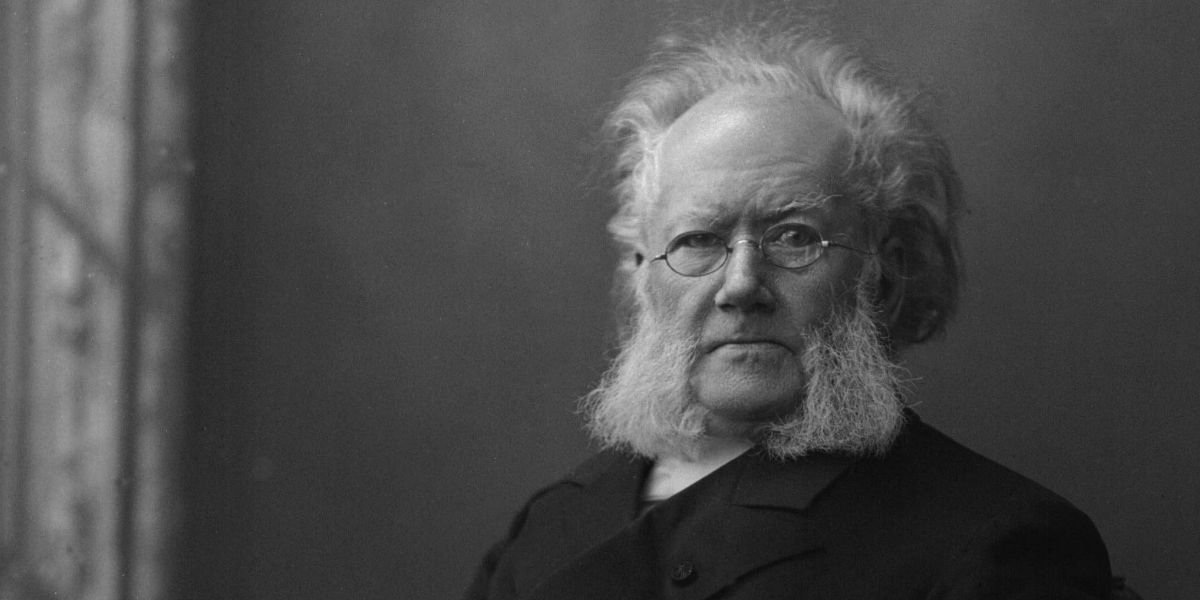
Henrik Ibsen was born on March 20, 1828, in Skien, Norway becoming the oldest of 5 children. At the age of 8 is family had finical problems and had to sell most of their belongings and moved to a rundown farm, where Henrik spent most of his time reading, painting and performing magic tricks.
Age 15 he got a job as an apprentice in an apothecary in Grimstad, he worked there for 6 years using what little free time he had to write poetry as well as paint.
In 1849, he wrote his first play Catilina, a drama written in verse modeled after one of his great influences, William Shakespeare.
He studied at the University of Christiania where he moved to in 1850 and became friends with many other artists and writers. Ole Schulerud a man he met there, paid for Henrik’s first play to be published, sadly it didn’t become one of much interest to the public.
In 1851 he was offered a job as a writer and manger of the Norwegian Theatre in Bergen. The job proved to be very stressful, he even had to go abroad in order to improve his abilities.
In 1857, Ibsen returned to Christiania to run another theater there. Once again it being an intense frustrating experience, even getting people complaining about how he should be ejected from the theatre, saying he did a poor, bad job of looking after it.
In 1862, Ibsen left Norway and soon settled down In Italy. 1865 was the year of Brand, a five-act tragedy about a clergyman whose feverish devotion to his faith costs him his family and ultimately his life; in was his first play that became famous in Scandinavia.
He went on to writing his most famous plays:
- Peer Gynt (1864)
- The Pillars of Society (1868)
- A Doll’s House (1879)
- Ghosts (1881)
- An Enemy of the People
- The Lady From the Sea (1888)
- Hedda Gabler (1890)
In 1891, Ibsen returned to Norway as a literary hero.
The first play written after his return to Norway was The Master Builder. The next piece was When We Dead Awaken, written in 1899. Ibsen was also known for writing over 300 poems.
In 1900, Ibsen had a series of strokes that left him unable to write. He managed to live for several more years, but he was not fully present during much of this time. Ibsen died on May 23, 1906. His last words were “To the contrary!” in Norwegian. Considered a literary titan at the time of his passing, he received a state funeral from the Norwegian government.
Peer Gynt, A Doll’s House and Hedda Gabler are the most widely produced plays today out of all of his pieces of work.
I performed, Hedda Gabler with Mae in my class and we had a real good laugh with it. Ibsen’s plays aren’t ones I would touch upon nor perform because I feel they are stiff and mostly speech rather then action but I can only say that from watching a clip of Hedda Gabler. I did enjoy performing out duolouge however and will read some more of his work to get a better understanding of it.
 Helen's Performing Arts Life